Introduction
Why does skin feel dry so fast? The answer often lies in hydration.A Moisturizing Agent helps retain water. It protects and restores the skin barrier.In this article, you will learn how a Moisturizing Agent works. You will understand how it improves skin health.

How a Moisturizing Agent Works on Skin
Role of the stratum corneum in water balance
The stratum corneum, which is the outermost layer of the skin, plays a critical role in maintaining water balance by acting as a barrier that prevents excessive moisture loss while allowing controlled interaction with the environment. This layer is structured like bricks and mortar, where skin cells are surrounded by lipids that help retain water and maintain flexibility.
How Moisturizing Agent increases skin water content
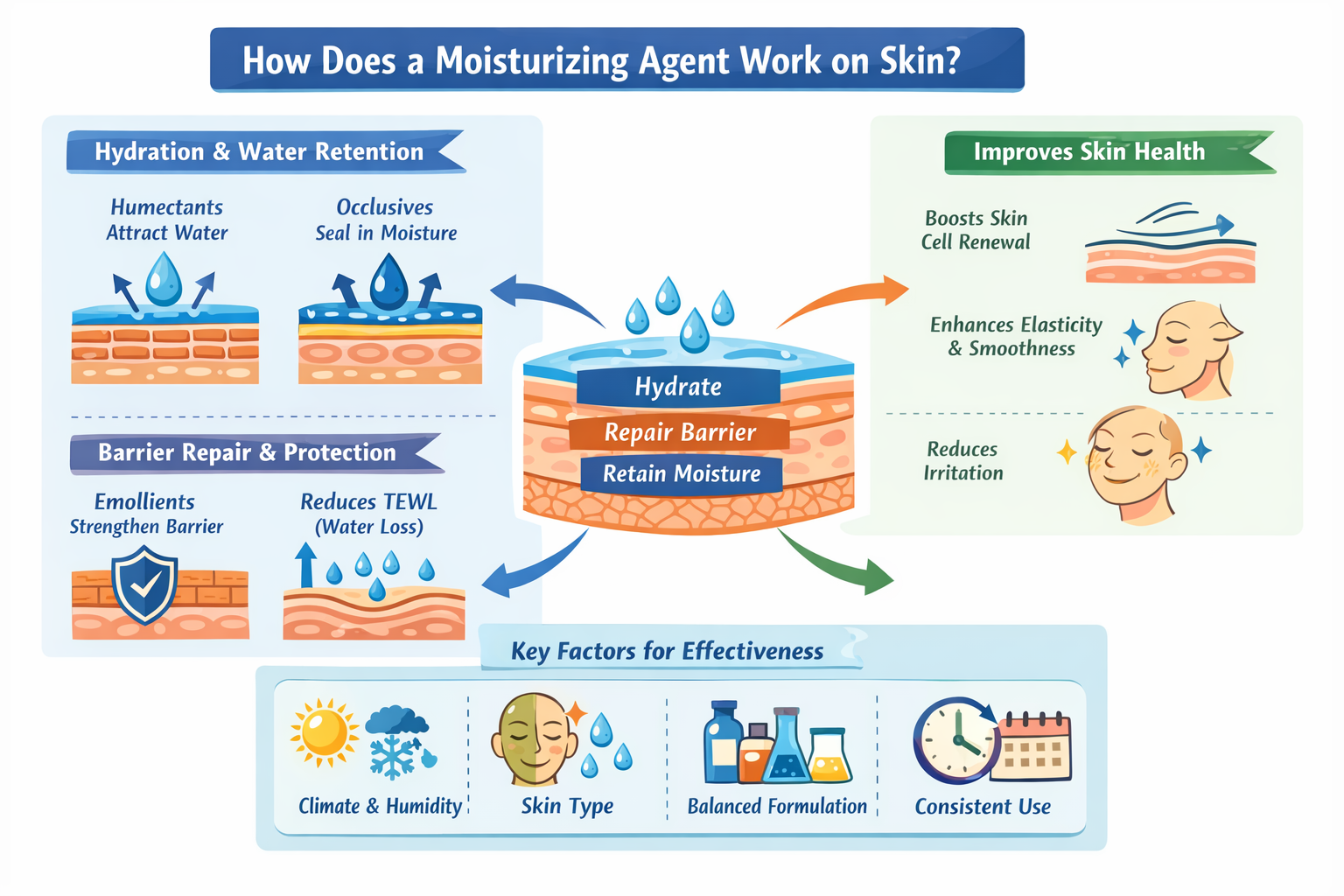
A Moisturizing Agent works by attracting water to the surface of the skin and holding it within the outer layers, either by drawing moisture from the environment or from deeper layers of the skin. This process enhances hydration levels and helps maintain a healthy moisture balance.
Mechanism of preventing TEWL
One of the key functions of a Moisturizing Agent is reducing transepidermal water loss (TEWL), which refers to the evaporation of water from the skin’s surface. By forming a protective layer, it slows down evaporation and ensures that moisture remains within the skin for longer periods.
Interaction with Natural Moisturizing Factor (NMF)
Natural Moisturizing Factor (NMF) consists of water-binding molecules such as amino acids and urea, and a Moisturizing Agent supports its function by enhancing water retention and maintaining optimal hydration conditions within the skin.
How Moisturizing Agent supports skin cell turnover
Proper hydration allows enzymes in the skin to function efficiently, which supports the natural shedding of dead skin cells and promotes healthier skin renewal, resulting in smoother and more refined texture.
Impact on skin texture, elasticity, and appearance
When skin is well hydrated, it becomes more elastic and flexible, reducing the appearance of fine lines and improving overall smoothness and brightness.
Synergistic action of multiple ingredient types
Modern formulations combine different types of ingredients that work together to enhance hydration, improve barrier function, and deliver both immediate and long-lasting results.
Combining multiple ingredient types in one formulation can significantly improve both performance and user experience.
Key Types of Moisturizing Agent and Their Functions
Different types of Moisturizing Agent ingredients perform specific roles, and understanding these functions helps in selecting the right formulation for different skin needs.
Humectant Moisturizing Agent
Humectants attract water molecules and bind them to the skin, increasing hydration levels and making them ideal for quick moisture replenishment.
Occlusive Moisturizing Agent
Occlusive agents create a protective layer on the skin surface that prevents water evaporation and helps maintain long-term hydration.
Emollient Moisturizing Agent
Emollients smooth the skin surface by filling gaps between cells, improving softness and overall texture.
Keratolytic agents
Keratolytic ingredients help remove dead skin cells and enhance absorption of other moisturizing components, improving the effectiveness of the formulation.
Each type of Moisturizing Agent serves a unique purpose, but the best results come from combining them.
Ingredients Commonly Used in a Moisturizing Agent
The effectiveness of a Moisturizing Agent depends on its ingredient composition, as different ingredients provide distinct benefits and work together to achieve optimal hydration.
Ingredient Type | Common Examples | Suitable Skin Type |
Humectants | Glycerin, Hyaluronic Acid | All skin types |
Occlusives | Petrolatum, Mineral Oil | Dry skin |
Emollients | Ceramides, Fatty Acids | Sensitive skin |
Actives | Urea, AHAs | Rough or flaky skin |
Humectants such as glycerin and hyaluronic acid are widely used because they effectively bind water, while occlusive agents like petrolatum help lock in that moisture. Emollients such as ceramides play a key role in restoring the skin barrier, and active ingredients like urea provide both hydration and gentle exfoliation.
Benefits of Using a Moisturizing Agent on Skin
Using a Moisturizing Agent regularly provides multiple benefits that go beyond simple hydration, contributing to overall skin health and appearance.
Improved hydration and reduced dryness
A Moisturizing Agent increases the water content in the skin, helping to reduce dryness and discomfort while maintaining a balanced moisture level.
Strengthened skin barrier and protection
By reinforcing the skin barrier, it protects against environmental stressors and reduces the risk of irritation and damage.
Smoother, softer, and more elastic skin
Hydrated skin becomes softer and more flexible, improving texture and reducing the appearance of fine lines.
Reduced irritation and better skin resilience
Consistent hydration helps calm sensitive skin and improves its ability to resist external irritants.
How to Choose the Right Moisturizing Agent
Selecting the right Moisturizing Agent depends on several factors, including skin type, environment, and product formulation.
Moisturizing Agent for dry skin vs oily skin
Dry skin requires richer formulations with strong occlusive properties, while oily skin benefits from lightweight, non-greasy products that provide hydration without clogging pores.
Lightweight vs rich formulations (lotion vs cream)
Lotions are lighter and absorb quickly, making them suitable for daytime use or oily skin, whereas creams provide deeper hydration and are ideal for dry or mature skin.
Ingredient combinations for different skin needs
Balanced formulations that combine humectants, occlusives, and emollients deliver better results by addressing multiple aspects of hydration.
Matching Moisturizing Agent to environmental conditions
Environmental factors such as temperature and humidity influence product performance, so formulations should be adapted accordingly.
Understanding your target market’s climate and skin concerns is critical for developing effective products.
How to Use a Moisturizing Agent Effectively
Proper application techniques play a crucial role in maximizing the effectiveness of a Moisturizing Agent, as even the best formulation can deliver suboptimal results if used incorrectly. For optimal performance, it is generally recommended to apply a Moisturizing Agent immediately after cleansing, when the skin is clean and more receptive to hydration, and to maintain a consistent routine by using it twice daily, in the morning and evening, to ensure stable moisture levels. Applying the product on slightly damp skin can further enhance its effectiveness, as residual water on the surface allows humectants to bind moisture more efficiently and improves overall absorption. In addition, adopting a proper layering strategy—starting with lightweight, water-based products such as serums and finishing with richer creams—helps lock in hydration and create a protective barrier that prevents moisture loss. However, certain common mistakes can significantly reduce the benefits of a Moisturizing Agent, such as overusing exfoliating ingredients, which may damage the skin barrier, or skipping moisturizer altogether, which can lead to dehydration and increased sensitivity. By following correct application methods and maintaining consistency, users can greatly improve hydration outcomes and support long-term skin health.
Factors That Affect Moisturizing Agent Performance
Several external and internal factors influence how well a Moisturizing Agent works on the skin, and understanding these factors helps optimize its effectiveness.
Climate and humidity influence
Climate plays a major role in skin hydration, as low humidity environments accelerate transepidermal water loss and make it more difficult for the skin to retain moisture, while higher humidity levels help maintain hydration by reducing evaporation. In colder or drier regions, richer and more occlusive Moisturizing Agent formulations are often required to compensate for increased moisture loss, whereas in humid climates, lightweight and fast-absorbing formulations are more suitable to avoid a heavy or greasy feel.
Skin type and condition differences
Different skin types, such as dry, oily, combination, or sensitive skin, respond differently to the same Moisturizing Agent, which makes personalization a critical factor in achieving optimal results. For example, dry or damaged skin often requires formulations with stronger barrier-repair ingredients like ceramides, while oily skin benefits more from non-comedogenic and lightweight humectant-based products. Additionally, compromised or sensitive skin may require gentler formulations to avoid irritation while still maintaining hydration.
Product formulation and ingredient balance
The effectiveness of a Moisturizing Agent is highly dependent on the balance and compatibility of its ingredients, as the correct ratio of humectants, occlusives, and emollients ensures both immediate hydration and long-term moisture retention. Poorly balanced formulations may either fail to deliver sufficient hydration or create undesirable textures such as excessive greasiness or stickiness. Advanced formulations often focus on synergistic ingredient systems that enhance performance while maintaining stability and sensory appeal.
Consistency of use and routine habits
Even the most effective Moisturizing Agent cannot deliver optimal results without consistent use, as hydration is not a one-time effect but an ongoing process that requires regular maintenance. Applying a moisturizer daily, especially after cleansing when the skin is more receptive, helps maintain hydration levels and strengthens the skin barrier over time. Inconsistent usage, improper application methods, or skipping key steps in a skincare routine can significantly reduce the overall effectiveness of the product.
Factor | Impact on Performance | Optimization Strategy |
Climate | Affects water loss rate | Adjust formulation type |
Skin Type | Determines absorption | Customize ingredients |
Formulation | Controls effectiveness | Balance components |
Usage | Influences results | Ensure consistency |
Consistent use combined with optimized formulation ensures maximum effectiveness.
Conclusion
A Moisturizing Agent works by combining hydration, barrier repair, and moisture retention to maintain healthy skin function and appearance, making it an essential component in both skincare routines and cosmetic formulations. By using the right combination of humectants, occlusives, and emollients, it is possible to create products that deliver both immediate hydration and long-term benefits.
Understanding how a Moisturizing Agent works allows users and manufacturers to make better choices, optimize product performance, and ensure that the skin remains hydrated, protected, and resilient over time. Guangzhou Shengruixiang Trading Co., Ltd. provides high-quality moisturizing ingredients and formulation support to help brands develop effective and reliable skincare products.
FAQ
Q: What is a Moisturizing Agent?
A: A Moisturizing Agent hydrates skin and protects its barrier.
Q: How does a Moisturizing Agent work?
A: A Moisturizing Agent attracts water and reduces moisture loss.
Q: Why is a Moisturizing Agent important?
A: A Moisturizing Agent improves hydration and skin comfort.
Q: How to choose a Moisturizing Agent?
A: Choose a Moisturizing Agent based on skin type and climate.
Q: Does a Moisturizing Agent affect cost?
A: Yes, Moisturizing Agent type and dosage affect product cost.